China’s cultural revolution

What is involved in understanding China’s Cultural Revolution?

The question comes to mind for several reasons — but most vividly because of a recent interview in France in the le nouvel Observateur with Song Yongyi. Song’s personal itinerary is historic — he was a “rebel Red Guard” in 1967, a political prisoner in China from 1970 to 1976, a librarian at Dickinson College in 1998, and a prisoner in China again in 1999 for six months for the “crime” of collecting documents about the Cultural Revolution. (See his website at California State University at Los Angeles.) Song is in the middle of creating a large database on the events of the Cultural Revolution, including especially an effort to document the killings and massacres that occurred during this period. Song estimates, for example, that more than 50,000 people were killed during the purge of the Mongolian Communist Party alone, and he attributes to an internal party document a figure of 1.72 million deaths during the period of the Cultural Revolution.

The question is interesting for UnderstandingSociety because it has to do with historical knowledge and understanding. A vast amount has been written about the Cultural Revolution — by western scholars and by Chinese people who participated in the CR or were victims of its violence. We have both first-hand stories and careful academic scholarship that document many aspects of this period of China’s recent history. So in one sense, we are in a position to know a lot about this period of China’s history. And China scholars have asked the “why” question as well — why did it take place? For example, Roderick MacFarquhar’s multivolume history of the period, culminating in Mao’s Last Revolution, goes into great detail about the politics that surrounded the CR. Also of great interest is Joseph Esherick, Paul Pickowicz, and Andrew Walder’s recent edited volume, China’s Cultural Revolution As History.

We might want to say, then, that the history of the Cultural Revolution has been written.

But as Song Yongyi demonstrates, this would be incorrect, in two ways. First, the scope of the violence and the ways in which it was perpetrated — the military and political institutions that were involved deeply in the transmission of the violence across China — these factual aspects of the period of 1966-76 are still only partially known. And there is reason to believe that the remaining areas of ignorance are likely to substantially change our interpretation of the events. In brief, it seems likely that the scope of violence and killings is substantially greater than what historians currently believe, and the degree of deliberate political control of the instruments of disorder is greater as well. So the simple factual question, what happened?, is still to be answered in many important areas. More would be known if the authorities were to make the official archives available to scholars; but this has been a highly sensitive and secretive subject since 1989.

Even more important than the factual story, though, is the explanatory story. We don’t yet have a good understanding of why this period of upheaval took place; what the social and political causes were, what the institutions were that facilitated or hindered the spread of disorder, and how these events aided or impeded the political agendas of powerful figures and factions in China. (When you visit the summer palace and Buddhist temples in Chengdu, for example, the guides tell you that these structures survived the destruction of the Red Guards because Deng Xiaopeng maintained control of the military in this region and gave orders to protect these historical structures.)

So the history of the Cultural Revolution still remains to be written. And this fact presents us with a very real question of historical epistemology: how much can we ultimately know about a vast and important event, for which there are voluminous archival sources and surviving witnesses? Can we hope to come to a “final” and approximately true interpretation of these events? And can we learn something important about social movements and political institutions from this history?

Ethnic violence and political entrepreneurs

We’ve seen horrendous instances of murderous violence among groups in a given society in the past century, often along ethnic and religious lines. Most recently there is the example of Kenya (article, article, article). But in the past twenty years we’ve also witnessed Bosnia, Rwanda, Darfur, Sri Lanka, India, and Iraq. (This is deliberately not to include societies like El Salvador or Guatemala where organized militias or death squads have deliberately murdered thousands of innocent people; these conflicts appear to have a different social cause.)

My question here is just a small piece of this large subject. What are the circumstances that cause apparently ordinary people to attack, torture, and murder their neighbors?

Commentators sometimes try to understand these horrific outbreaks in terms of a background theory of essential ethnic or religious identities defining groups that can then explode into murderous intra-societal violence. This is what some call a primordialist theory — the language of “tribalism” suggests the same idea. On this theory, ethnic conflict is taken as inherent in ethnic difference.

However, it is important to realize that this theory is almost always incorrect. The fact of ethnic or religious difference by itself does not create violence between groups, and often these identities don’t even figure importantly in ordinary social life. Instead, there are other factors at work in specific social circumstances that bring about ethnic mobilization and violence. (Donald Horowitz goes through many specific examples of multi-ethnic societies — some with violence and some without; Ethnic Groups in Conflict, Updated Edition With a New Preface.) Ethnic violence appears to be almost always a political process, involving leadership and organization.

In particular, political scientists who study ethnic conflict argue that there are usually underlying processes of political mobilization underway, led by opportunistic leaders who deliberately mobilize support around ethnic identities and ethnic hatred. These instigators can be called “political entrepreneurs”, and their strategies can be discerned in many of the century’s worst instances of inter-group violence. Hatred and violence are simply tools of mobilization for these leaders and parties. (Atul Kohli goes through a careful analysis of Hindu nationalist mobilization leading to anti-Muslim violence in Democracy and Discontent. Ashutosh Varshney’s Ethnic Conflict and Civic Life: Hindus and Muslims in India is also an important contribution.)

And it appears that evidence of just these sorts of processes of opportunistic mobilization by leaders on the ground can be found in the reporting available about the current violence in Kenya. Reportage in January about the post-election violence in Kenya provided multiple reports of messages of hatred being disseminated through cell phone networks, and of advance preparation of the organized violence that would emerge — before the election occurred. The violence that swept across Kenya was not a primordial outburst; it was an organized political effort — or so the reports would indicate.

These “ethnic hatred” politicians have done enormous harm in so many societies; and it must be a first order of priority to find ways of stamping out this form of politics.

Rights and violence in China

There is a pretty vibrant conversation going on internationally and in China about the role that individual rights should play in Chinese society. (There was an interesting conference on this subject at the University of Michigan early in February.) Some theorists object to the idea of formulating China’s issues of state-society relations in terms of individual rights. They object that the theory of individual rights is an expression of liberal or neo-liberal morality, and that this theory doesn’t give enough expression for the value of the society as a whole.

Other social scientists document the fact that there are a variety of increasingly visible groups in China who are formulating their claims in terms of rights: peasants in terms of their rights of land use, workers in terms of their labor rights, urban homeowners in terms of incursions against their homes by land developers, and city dwellers in terms of their rights against environmental harms. In each case the groups consist of people who have a deep and shared interest in something — access to land, working conditions that are safe and compensated, immunity from environmental toxins, security of their homes; these interests are threatened by powerful interests in Chinese society; and people in these groups want to have the freedom to struggle for their rights, and they want the state to have a system of law that protects them against violence when they do so. (Kevin O’Brien documents some of these social movements in Rightful Resistance in Rural China.)

So what is involved in advocating for “legality” and “individual rights” for China’s future? Most basically, rights have to do with protection against repression and violence. The core rights that Western political theorists such as John Stuart Mill, Immanuel Kant, or John Locke articulate are rights like these: freedom of association, freedom of action, freedom of expression, freedom of thought, and the right to security of property. Karl Marx criticized these rights as “bourgeois rights”, and some post-modern theorists today denigrate these rights as a vestige of liberalism.

But I want to assert that these rights are actually fundamental to a decent society — and that this is true for China’s future as well. Moreover, I want to assert that each of these rights is a reply to the threat of violence and coercion. Take the rights of expression and association: when a group of people share an interest — let’s say, an interest in struggling against a company that is dumping toxic chemicals into a nearby river — they can only actualize their collective interests if they are able to express their views and to call upon others to come together in voluntary associations to work against this environmental behavior. The situation in China today is harshly contrary to this ideal: citizens have to be extremely cautious about public expression of protest, and they are vulnerable to violent attack if they organize to pressure companies or local government to change their behavior.

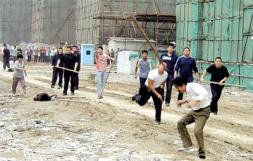
The use of private security companies on behalf companies, land developers, and other powerful interests in China is well documented — as it was in the labor struggles of major industries in the United States from the 1880s to the 1930s. And these companies are pretty much unconstrained by legal institutions in their use of violence and gangs of thugs to intimidate and attack farmers, workers, or city dwellers. It’s worth visiting some of the web sites that document some of this violence — for example, this report about thugs attacking homeowners in Chaoyang. Similar reports can be unearthed in the context of rural conflicts over land development and conflicts between factory owners and migrant workers.

So this brings us to “legality.” What is the most important feature of the rule of law? It is to preserve the simple, fundamental rights of citizens: rights of personal security, rights of property, rights of expression. Why, in the photos included in the web site above involving an organized attack by security thugs against innocent Chaoyang residents — why are there no police in the scene making arrests of these thugs? And what does it say to other people with grievances? What it says is simple — the state will tolerate the use of force against you by powerful agents in society. And what this expresses is repression.

It is also true that the state itself is often the author of repression against its own citizens for actions that would be entirely legitimate within almost any definition of core individual right: blogging, speaking, attempting to organize migrant poor people. When the state uses its power to arrest and imprison people who speak, write, and organize — it is profoundly contradicting the core rights that every citizen needs to have.

It should also be said that these legal rights cannot be separated from the idea of democracy. Democracy most fundamentally requires that people be able to advocate for the social policies that they prefer. Social outcomes should be the result of a process that permits all citizens to organize and express their interests and preferences — that is the basic axiom of democracy. What this democratic value makes impossible is the idea that the state has a superior game plan — one that cannot brook interference by the citizens — and that it is legitimate for the state to repress and intimidate the citizens in their efforts to influence the state’s choices. A legally, constitutionally entrenched set of individual civil and political rights takes the final authority of deciding the future direction of society out of the hands of the state.

Give Chinese people democratic rights and they can make some real progress on China’s social ills — unsafe working conditions, abuse of peasants, confiscation of homeowners’ property, the creation of new environmental disasters. Deprive them of democratic rights, and the power of the state and powerful private interests can create continuing social horrors — famine, permanent exploitation of workers, environmental catastrophes, development projects that displace millions of people, and so on. The authoritarian state and the the thugocracy of powerful private interests combine to repress the people.

So let’s not fall for the post-modern jargon, the equation of liberal democratic values with neo-conservative politics or worse, and let’s advocate strongly for a Chinese society that incorporates strong legal protections for individual rights and liberties.